

Network and Distributed Filesystems on Linux: What We Learned the Hard Way
Before settling on modern object storage for LightUpOn.Cloud, we spent considerable time evaluating traditional network and distributed filesystems on Linux. The investigation revealed recurring structural problems that make these solutions high-maintenance and risky for production environments handling large-scale or business-critical data.
The Persistent Challenges of Network Filesystems
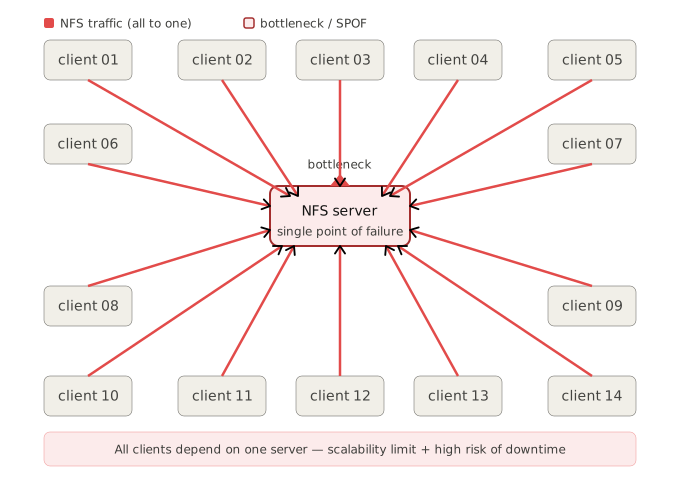
Network filesystems like NFS were designed for relatively small to mid-size installations with predictable workloads. In practice, they frequently become single points of failure. When a partition fills up, administrators face the tedious task of moving volumes between servers and remounting them across the infrastructure. Scalability remains limited, and performance can degrade unpredictably under heavy concurrent access.
GlusterFS and Distributed Alternatives
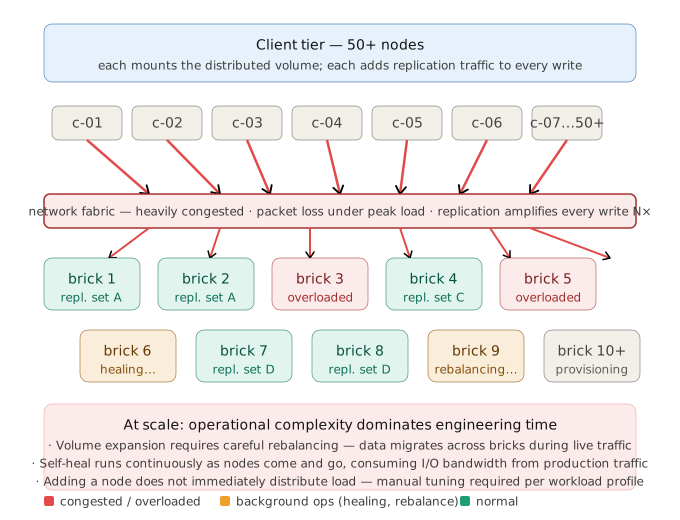
GlusterFS promised nearly unlimited scalable storage through its translator-based architecture. In reality, it came with significant operational friction. It struggled with large numbers of small files (listing a directory with just 3,500 files could take 20 seconds), required precise NTP synchronization, and suffered from single points of failure in its nameserver. Performance tuning was notoriously difficult — optimizations for one workload often crippled another.

Other distributed options showed similar patterns. OpenAFS offered interesting replication features but was complex to administer. GFS2 and OCFS2 required dedicated shared storage and carried their own limitations in locking, ACL support, and production readiness. PVFS (designed for HPC) sacrificed fault tolerance for performance, while Ceph — despite improvements over the years — still demands careful tuning of block sizes and can underperform in general-purpose scenarios.
The Maintenance Burden
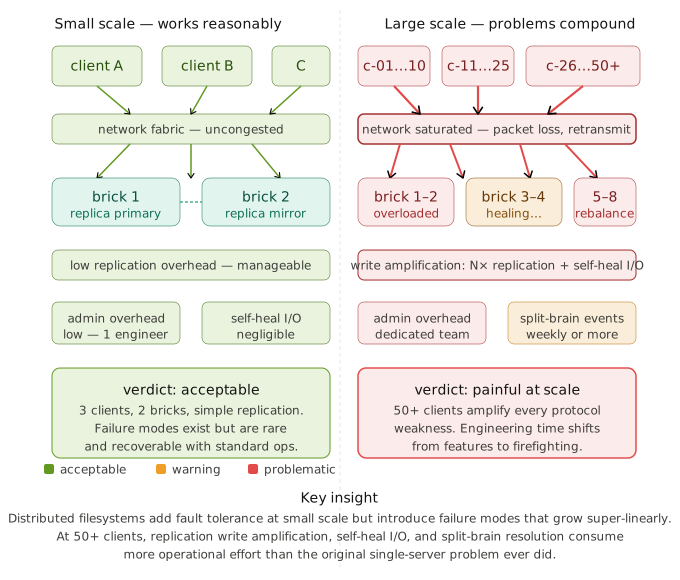
Across nearly all network and clustered filesystems we tested, a common theme emerged: high operational overhead. Administrators spend disproportionate time managing volume migrations, balancing load, handling split-brain scenarios, and recovering from node failures. Many solutions introduce single points of failure or require complex kernel patches and ongoing maintenance that simply do not scale economically as data volumes grow.
Why We Chose Object Storage
These experiences led us toward object storage architectures. Systems like Riak CS (S3-compatible) address the core weaknesses of traditional network filesystems by providing built-in distribution, predictable fault tolerance, and strong consistency models without the administrative complexity of managing filesystem volumes and mounts. The S3 protocol also ensures vendor neutrality and straightforward migration paths.
For LightUpOn.Cloud, this foundation enables reliable high-performance synchronization while avoiding the fragility and maintenance burden that often accompanies network filesystem deployments in production environments.