

Why Europe's SMBs Are Switching from Dropbox and OneDrive to Sovereign File Sync
For many European SMBs dealing with large binary files — whether CAD models, medical imaging, or research datasets — the daily reality of cloud file sync has become a source of quiet frustration. What begins as a convenient sharing tool often turns into a performance bottleneck, an unpredictable cost center, and a growing compliance headache. With 24.7 million SMBs in the EU and the Enterprise File Sync and Share (EFSS) market expanding at roughly 26% CAGR, these pain points are no longer edge cases.
Dropbox and Microsoft OneDrive/SharePoint were optimized for a particular environment: document-centric workflows, primarily US-jurisdiction infrastructure, and users tolerant of internet-dependent performance. They work well for lightweight collaboration. When applied to data-heavy European use cases, however, their architectural assumptions start to show. Internet latency across borders, per-user licensing that scales poorly with team size, capped version history, and evolving terms around AI training of stored content create structural mismatches that are difficult to ignore.
A Different Architectural Approach
LightUpOn.Cloud was developed as a direct response to these constraints. Rather than layering additional features onto a consumer-first cloud model, the platform was built from the ground up for organizations that require both high performance and control over their data location.
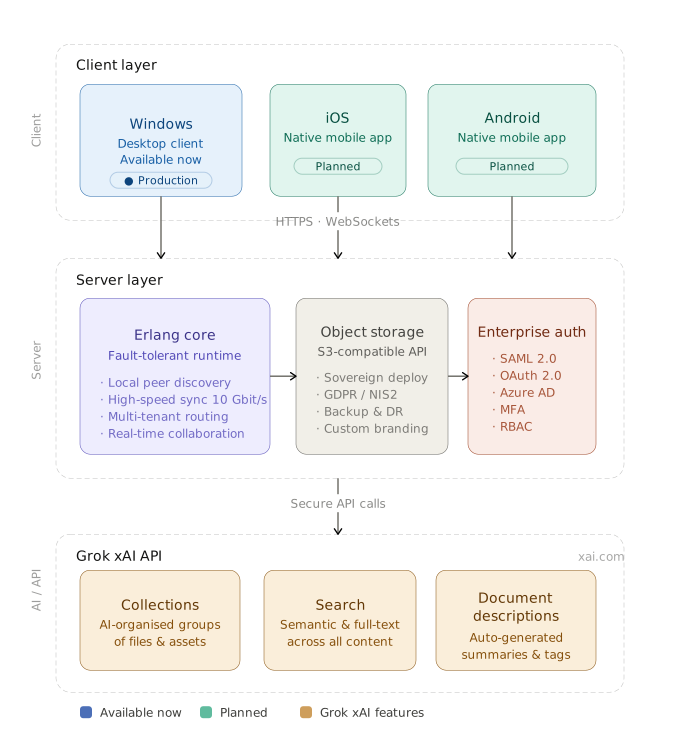
The server component runs on the Erlang Open Telecom Platform (OTP), a runtime originally designed for telecommunications systems that must maintain high availability under heavy concurrent load. Erlang’s strengths in fault tolerance and massive concurrency translate well to file synchronization workloads. The storage layer uses an S3-compatible open protocol, allowing deployment on any compatible infrastructure — on-premise, in EU private clouds, or hybrid setups — without vendor-specific dependencies.
Communication relies on standard HTTPS and WebSockets, while local peer discovery enables LAN synchronization at speeds up to 10 Gbit/s when devices are on the same network. This combination produces measurable differences in practice: transfers that previously waited on internet uplinks can now complete at local network speeds.
Concrete Operational Differences
For organizations handling large files, several distinctions become material. Synchronization performance can reach up to 10× that of cloud-dependent solutions in LAN environments. Total cost of ownership tends to run 4–5× lower than comparable Dropbox Business or OneDrive for Business plans, largely due to unlimited users and devices rather than per-seat licensing. Version history extends beyond 365 days, compared to the roughly 30-day retention common in the major cloud offerings.
Data never leaves EU-controlled infrastructure unless the customer chooses otherwise, addressing jurisdiction concerns under GDPR and NIS2. The open S3 protocol means migration away from the platform remains feasible without proprietary format conversion. Advanced file locking and check-out mechanisms help prevent concurrent edit conflicts on large binary files such as CAD, BIM, or video assets — a frequent source of errors in less specialized tools.
Unlike several major providers that have updated terms to permit training of AI models on stored customer content, LightUpOn.Cloud maintains a clear policy against such usage.
A Typical Use Case
Consider an architecture firm with offices in Berlin, Warsaw, and Madrid working on a 40 GB BIM project. Under traditional cloud sync, team members wait for large model files to traverse internet connections, version conflicts arise on shared binaries, and costs scale with every additional license. With on-premise or EU-hosted deployment, the same team can leverage local network speeds for internal collaboration while maintaining secure external sharing channels. The firm retains full control over data location and benefits from extended version history without proportional cost increases.
Similar patterns appear in private healthcare practices managing sensitive patient data and in R&D environments — such as the validated deployment at Ericsson’s Athlone facility — where predictable performance and sovereignty matter more than consumer-grade convenience.
Regulatory Tailwinds
The timing aligns with broader European policy direction. The NIS2 Directive and strengthened GDPR enforcement raise the bar for data handling and incident reporting in ways that are structurally more complex when data resides on US-jurisdiction infrastructure. The European Commission’s Digital Sovereignty agenda explicitly encourages development of competitive alternatives to hyperscaler dominance. For IT leaders evaluating long-term infrastructure, these factors add weight to technical and economic considerations that already favor more controllable solutions.
The shift is less about rejecting cloud capabilities entirely and more about recognizing when a solution’s original design assumptions no longer match operational and regulatory reality. For file-heavy European SMBs, that reassessment is increasingly leading toward architectures that prioritize sovereignty and performance on their own terms.
| Feature | LightUpOn.Cloud | Dropbox Business | OneDrive for Business |
|---|---|---|---|
| Data Jurisdiction | EU-controlled / On-premise | Primarily US | Primarily US |
| Sync Speed (LAN) | Up to 10 Gbit/s | Internet-limited | Internet-limited |
| Version History | >365 days | ~30 days | ~30 days |
| Pricing Model | Capacity-based, unlimited users | Per user | Per user |
| Vendor Lock-in Risk | Low (open S3 protocol) | High | High (Microsoft ecosystem) |
| AI Data Usage Policy | No training on customer data | Permitted per terms | Permitted per terms |